
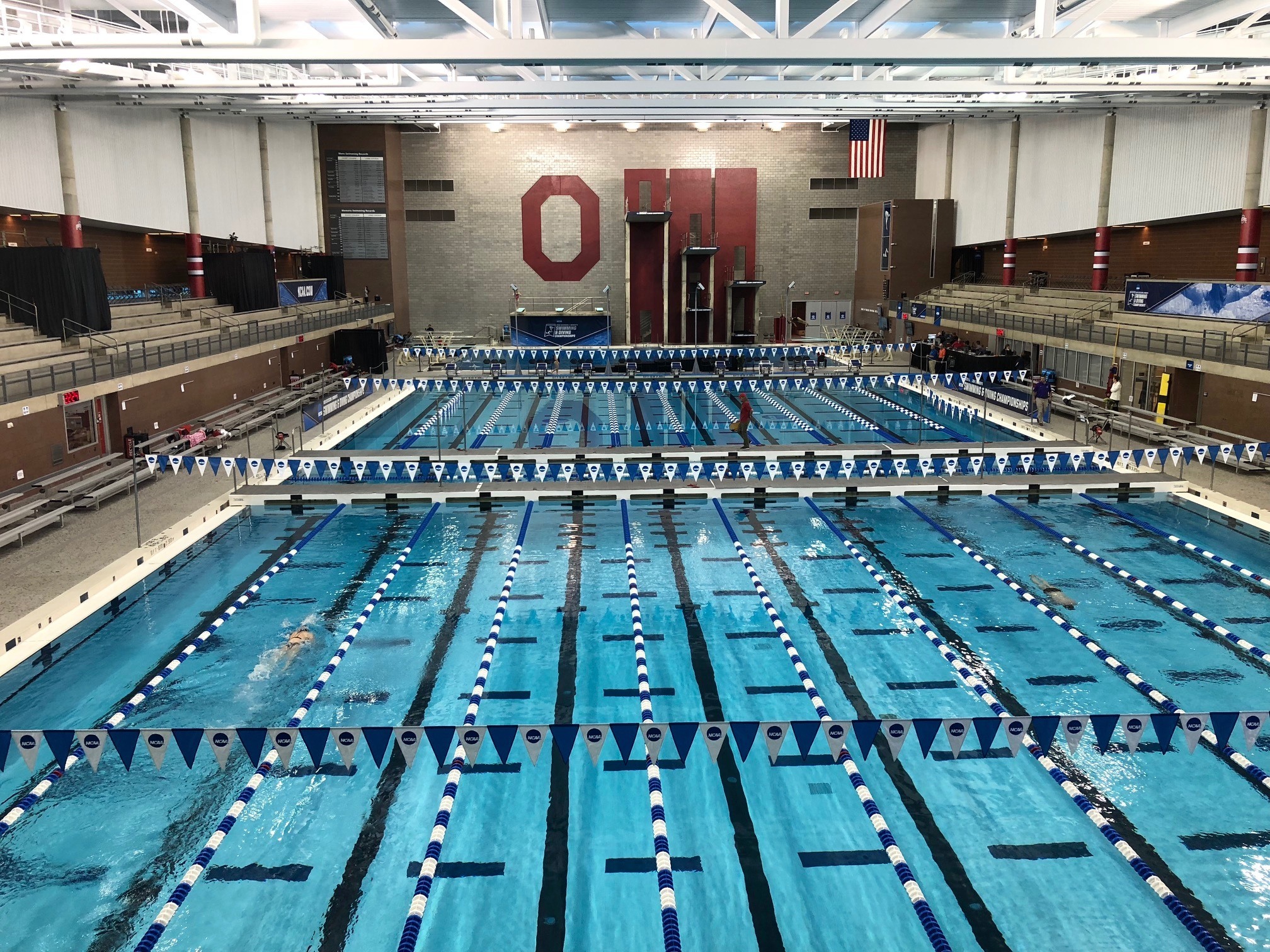
I recently had the opportunity to speak with a performance psychology class at the University of Oregon, and it got me reflecting on my own experience as a collegiate swimmer at Ohio State.
I found myself torn between creating a more polished presentation on performance psychology or a brutally honest one. In the end, I played it safe. I shared reflections on wishing I had known how to better regulate my nervous system, face fears of judgment and failure, and understand what may have held me back from reaching my full athletic potential.
But here is the fully honest one.
What It Really Felt Like Behind the Scenes
The 19-year-old version of me who showed up on the pool deck at Ohio State was a mess.
I had competed at the University of Kentucky my freshman year, and while I swam well, the program wasn’t the right fit. I decided to transfer. I had dreamed of qualifying for Olympic Trials since I was 11, and I believed Ohio State could get me there.
I arrived in Columbus wildly out of shape, knowing I had a grueling journey ahead just to get back to where I had been physically. We trained long course for four hours a day, and I still remember pulling myself out of the pool one afternoon, my face as red as a cherry. My coach chuckled and asked, “You alright, Kelly?”
The team was stacked with incredibly talented, competitive athletes. I felt surrounded by type A, overachieving personalities, and overnight I felt average at best.
Like any major transition, I was juggling a new team, new coach, new friends, new city, and new classes. I was grieving the friends I had left behind, trying to establish a sense of belonging, all while beginning to process childhood sexual abuse I had experienced years earlier.
At the time, I was not consciously aware of just how much I was carrying. And neither was my coach.
When You Look Fine, But You’re Not
On the surface, I held it together. I hid behind smiles and laughter. But internally, I was riddled with anxiety, loneliness, and fear.
I started seeing a sport psychologist but I remember telling him early on I had already dealt with the trauma.
Looking back now, I can see I wasn’t ready to fully face it.
It felt more manageable to frame it as something in the past, something resolved, rather than something that was still actively shaping how I felt, how I coped, and how I showed up.
We never actually got around to talking about swimming.
The Coping That Held Me Back
As a form of protection, I put on a front with my team that I did not care, that I could not be rattled. It felt safer for people to believe I was not fully invested than to risk them seeing how deeply I actually cared.
Avoidance became my way of coping.
And in many ways, I think that is what got in the way of me fully reaching my athletic potential.
Not a lack of discipline.
Not a lack of effort.
Not a lack of desire.
But a nervous system under stress, and a lack of the awareness, support, and readiness I needed to fully face and process what I was carrying.
The Moment That Stayed With Me
At my senior banquet, my coach stood up and said something I will never forget.
“Kelly could have been world class. She just didn’t want to be.”
It could not have been further from the truth.
I cared so deeply about swimming. But I did not have the tools I needed to process trauma while performing at a high level, while navigating the academic and social pressures of college.
And quite honestly, I do not know many 19-year-olds who do.
What I See Now That I Couldn’t See Then
Looking back now, my reflections are not about wishing I had slept more, eaten more protein, worked harder, or done breathwork before races.
Those things matter. But they were never the core issue.
What I needed was support in understanding what was happening internally.
I needed space to process.
I needed tools to regulate.
I needed permission to not be okay.
And most of all, I needed someone to recognize that performance struggles are often not about performance at all.
For the Student Who Feels Like They’re Falling Behind
If you are a student, athlete, or high achiever navigating a major transition, and you feel like you are falling behind or not living up to your potential, there is a good chance there is more going on beneath the surface.
You might be carrying:
- anxiety
- loneliness
- pressure to prove yourself
- grief from what you have left behind
- or experiences you have not yet had the space to process
And still, you are expected to perform.
That is a lot for anyone, let alone someone who is 18 or 19 years old.
Often, what looks like underperformance is actually a nervous system under stress.
What looks like lack of motivation can be overwhelm.
What looks like not caring can be protection.
The Work I Do Now
This is the work I now do with teens and young adults, especially those navigating transitions like starting university.
Together, we focus on:
- understanding and regulating the nervous system
- building emotional resilience and self-awareness
- creating a sense of stability during times of change and transition
- processing underlying trauma that impact performance and well-being
Because when students are supported emotionally, performance often follows.
What I Would Tell My 19-Year-Old Self
I wish I could go back and hug that version of me, the one who was shutting down under pressure and fear, carrying so much at once, and doing the best she could without the tools to process it all.
I would tell her there is no perfect way to handle everything she is facing.
She is allowed to fall apart.
She is allowed to not be okay.
And she is not alone.
If you’re a student preparing for university, or a parent supporting one, and this resonates, you don’t have to navigate it alone. Feel free to reach out to learn more about how I support students through this transition.
📩 Reach out today to connect with Kelly kellytituscounseling@gmail.com
📸 Know someone who might need to hear this? Feel free to share it.